"Off the floor," Walt said. "Both of you. Now."
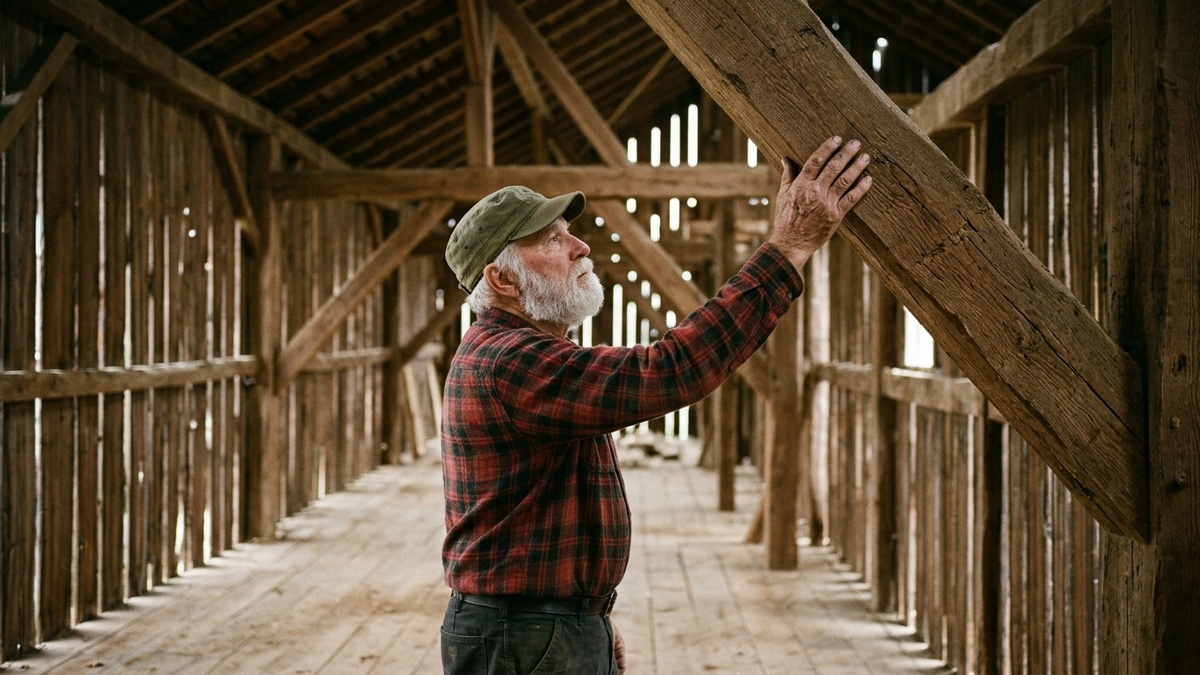
Sam and Brandon backed toward the big doors. Walt stayed where he was on the scaffold, very still, with his hand on the beam and his eyes on the chandelier.
The wagon wheel swung slowly on its chain. It made one long circle and settled.
Walt waited. He counted to sixty. Then he counted again.
Nothing moved.
"Is it going?" Brandon called from the door.
"Not yet," Walt said. "But it's thinking about it."
He climbed down and walked under the beam, looking up. The crack had jumped almost three feet. It was nearly at the chandelier bolt now. He could see light through it in one place.
"First thing," Walt said, "we take the weight off."
They rigged a second chain from the roof plate above and took the strain of the chandelier off the tie beam. Brandon cranked the come-along slowly while Walt watched the crack. When the chain went tight, the wagon wheel lifted a quarter inch and hung there on its own.
The beam made a long, low sound, almost like a sigh.
"Now," Walt said, "we give her a brother."
Sistering a beam was old work. Walt had learned it from Emil Lutz in 1979, the year he bought his farm, when they repaired the hayloft in Emil's barn together. You lay a new timber tight against the old one, side by side, and bolt them through so the two act as one. The new wood carries the load until the old wood remembers how.
They raised the white oak the rest of the way on the hoist. Walt guided it in with his hands, inch by inch, until it lay tight against the old beam from post to post. Sam held it with a pry bar. Brandon handed up clamps.
Then Walt took the big auger and began to bore.
It was slow, hard work. Each hole went through ten inches of new oak and ten inches of old. Walt bored by hand, the way Emil had shown him, so he could feel the wood the whole way through. When the bit hit the old oak, it changed pitch. When it came near the crack, it changed again. He went slower there.
Around midnight, Brandon handed up a bolt and stayed on the ladder a moment.
"You looked at that wagon wheel a long time in September," he said. "The day we hung it. I saw you from the lane. You didn't say anything."
"Wasn't my barn."
"I wish you had."
Walt fitted the bolt into its hole and tapped it home with a mallet.
"I'm saying it now," he said.
At one in the morning, Sam brought up coffee. At two, Jenna came out in her coat and boots and held the flashlight. At three, Owen appeared in his pajamas in the doorway with the kitten, and Jenna carried him back to bed without either of them saying a word.
By four-thirty, there were eight long bolts through both timbers, washers and nuts snugged down tight. Walt went along them one by one with a wrench, a quarter turn at a time.
At five, the temperature hit its lowest point of the night. Walt sat on the scaffold with his hand on the beam and listened.
Nothing walked.
Walt let out a long breath and patted the old beam twice, the way you would pat a horse that had finally stood still for the farrier.
The bride from Columbus arrived at eleven on Saturday morning. Her name was Kelsey. She walked into the barn and stopped in the doorway and put both hands over her mouth.
The tablecloths had been washed and pressed and laid out fresh. Jenna had wrapped the new white oak beam in pine garland and tiny white lights, so the first thing anyone saw looking up was a long, glowing line running the length of the barn. The wagon wheel hung beneath it, lit with candles.
"It's even prettier than the pictures," Kelsey said.
Brandon stood beside Walt at the back. He had shaved, but he still looked like a man who had been up all night, because he had.
"I don't know how to pay you back," he said quietly.
"You don't," Walt said. "You just keep this barn standing."
The wedding went until midnight. A hundred and forty people ate and danced under the beams. The photographer from Cleveland took a picture of the bride and groom under the glowing white oak, and later it ended up on the front of a magazine for Ohio brides. Brandon booked eleven more weddings in the next six weeks. The bride's grandmother, who was eighty-eight, asked Walt to dance. He told her he didn't dance. She said neither did she, and they danced anyway.
Owen found Walt the next morning in the lane, back at work on the culvert. Biscuit and the kitten were sitting together in the sun.
"The ghost didn't walk last night," Owen said. "I snuck and listened."
"No," Walt said. "I don't believe it will."
"Where did it go?"
Walt thought about that one honestly.
"It was the barn," he said. "Telling us something was wrong."
Owen nodded slowly, as if this made perfect sense.
That night, Walt sat on his own porch at ten o'clock with Biscuit beside him and a cup of coffee going cold, and listened to the barn up the hill stand silent in the frost, the way a good barn should.